
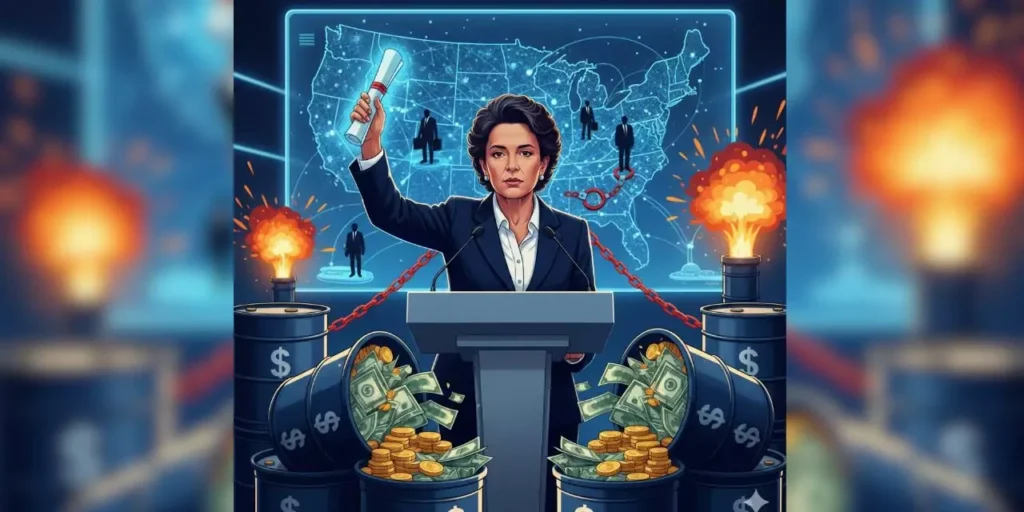
The president of Mexico, Claudia Sheinbaum Pardo, confirmed this Thursday that there are extradition requests against American businessmen allegedly involved in the so-called fiscal huachicol. A fuel smuggling scheme that avoided paying taxes when entering hydrocarbons into the country.
During her morning conference, the president maintained that the investigation is in the hands of the Attorney General’s Office (FGR), the body responsible for reporting on progress and possible names of those involved, within the framework of due process.
EXTRADITIONS IN PROGRESS AND COOPERATION WITH THE USA
Faced with questions about coordination with US authorities, Sheinbaum confirmed that some of the aforementioned businessmen face proceedings in both Mexico and the United States.
“Yes, they are businessmen who were dedicated to being part of the entry of fuel without paying taxes to Mexico, and there is a request for extradition,” he declared.
The president also confirmed that among those involved is the Jensen family, identified as a key player in the smuggling network.
WHO ARE THE JENSEN?
According to official information, the Jensens introduced 2,881 shipments of crude oil into Mexico over three years, pretending that they were other substances to evade customs taxes.
The illicit operation would have generated profits estimated at 300 million dollars. To operate, they allegedly had support from the Jalisco New Generation Cartel (CJNG), a criminal organization that would have received payments as compensation.
Unlike the traditional flow—from refineries in Texas to Mexican territory—the network reversed the trade route to obtain undue tax benefits. The structure was dismantled in April by US authorities.
NO INVESTIGATION AGAINST FORMER SECRETARY OF THE NAVY
On another issue, the president ruled out that there is a line of investigation against the former Secretary of the Navy, José Rafael Ojeda Durán. After audios were released about an alleged meeting with naval commanders.
Sheinbaum clarified that the investigation focuses exclusively on the prosecutor’s huachicol network and recalled that there were previously arrests of Navy personnel, cases that – he said – were denounced by the admiral himself.
TRACEABILITY AND QR CODES: EFFECTIVE SOLUTION?
As part of the actions to combat fuel theft and smuggling, the president highlighted the implementation of mandatory QR codes on pipes that transport hydrocarbons.
As he explained, the code – issued by the Ministry of Energy – allows the origin, destination and buyer of the fuel to be verified in real time. If the unit does not have this badge, it may be detained and placed at the disposal of the FGR.
Sheinbaum assured that this traceability system, in coordination with the SAT, Customs and Pemex, has significantly reduced illegal transportation. However, specialists warn that the challenge is not only technological, but structural: corruption in customs and collusion with criminal groups have been persistent factors in the illicit fuel market.
A CASE THAT REVEALS BINATIONAL FAILURES
The Jensen case exposes a sophisticated scheme that operated for years undetected. Which raises questions about oversight mechanisms in both Mexico and the United States.
Although the federal government highlights progress in traceability and international cooperation, the scale of the fraud—thousands of shipments and hundreds of millions of dollars—suggests institutional gaps that still need to be closed.
The investigation remains open.
You may also like
-
Former Prince Andrés arrested on his 66th birthday for the Epstein case
-
Peru dismisses its interim president two months before elections and deepens the crisis
-
Jesse Jackson dies at 84: civil rights leader who paved the way for Barack Obama
-
The United Kingdom prepares a ban on social networks for those under 16 and tightens control over AI
-
Shooting at the University of South Carolina leaves two dead and closes the campus