
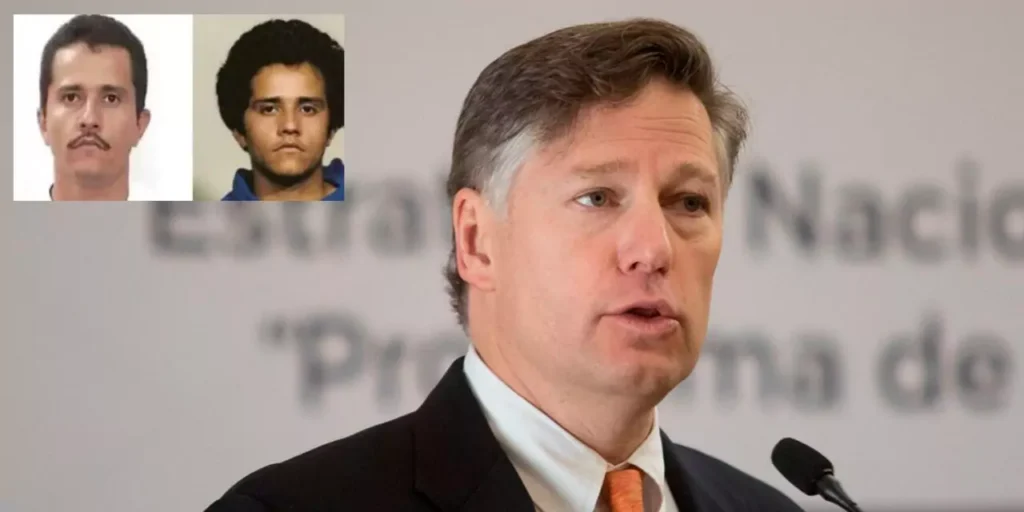
The United States Undersecretary of State, Christopher Landau, was one of the first foreign officials to speak out about the death of Nemesio Oseguera Cervantes, alias “El Mencho”, leader of the Jalisco New Generation Cartel (CJNG), which occurred after a military operation in Tapalpa, Jalisco.
Through his account on X, the official described the event as “an important event for Mexico, the United States, Latin America and the world.”
“I have just been informed that Mexican security forces killed El Mencho, one of the most bloodthirsty and ruthless drug lords,” he wrote.
The message concluded with a phrase in Spanish:
“The good ones are more than the bad ones. Congratulations to the public order forces of the great Mexican nation.”
The reaction showed the weight that Washington gave to the criminal leader, considered by US agencies as one of the priority objectives in the fight against drug trafficking.
SECOND MESSAGE: CONCERN ABOUT CRIMINAL RESPONSE
Minutes later, Landau qualified his initial position by referring to the riots and blockades registered in several Mexican states after learning of the kingpin’s death.
“I follow the scenes of violence with great sadness and concern (…) It is not surprising that the bad guys respond with terror. But we must never falter,” he published, closing with a “Cheer up Mexico!”
His words reflect the duality facing American anti-drug policy: celebrating strategic strikes against criminal leadership and, at the same time, recognizing that these can trigger violent reactions.
OPERATION WITH BINATIONAL SUPPORT
The Secretary of National Defense reported that Oseguera was injured during a confrontation with military forces in Tapalpa and died “during his transfer by air to Mexico City.”
The agency added that, in addition to the central military intelligence work, there was “complementary information” provided by US authorities.
The official balance was seven alleged criminals dead, three soldiers injured and two members of the CJNG detained. High-powered weapons were also seized, including rocket launchers capable of shooting down aircraft.
BLOCKADES AND REACTION IN JALISCO AND MICHOACÁN
After the operation, armed individuals carried out blockades with burned vehicles on different roads in Jalisco. The actions extended to the neighboring state of Michoacán, where the cartel also maintains a presence.
Local authorities recommended the population not to leave their homes due to the risk of new incidents.
A CARTEL WITH A HISTORY OF VIOLENCE
The CJNG, founded in 2009, established itself as one of the most violent criminal organizations in the country, according to the United States Department of Justice. Washington has designated it as a terrorist organization and links it to the trafficking of cocaine, heroin, methamphetamine and fentanyl.
Oseguera was also identified as responsible for ordering the attack against Omar García Harfuch on June 20, 2020 in Mexico City, an attack in which three people died and the then official was injured.
A BLOW THAT RECONFIGURES THE SCENARIO
The public reaction of a senior US official underscores the international impact of the operation. However, the violence unleashed in the hours that followed confirms that the fall of a criminal leader does not necessarily imply the immediate end of the threat, but rather the beginning of a new stage of tension and uncertainty.
You may also like
-
Gunman dies after breaking into Mar-a-Lago; Trump was not in the residence
-
Trade war 2026: Trump raises global tariff to 15% after Supreme Court setback
-
Mexico and the US launch massive campaign against screwworm to reopen the border
-
Sheinbaum confirms extraditions for fiscal huachicol and uncovers binational network
-
Former Prince Andrés arrested on his 66th birthday for the Epstein case