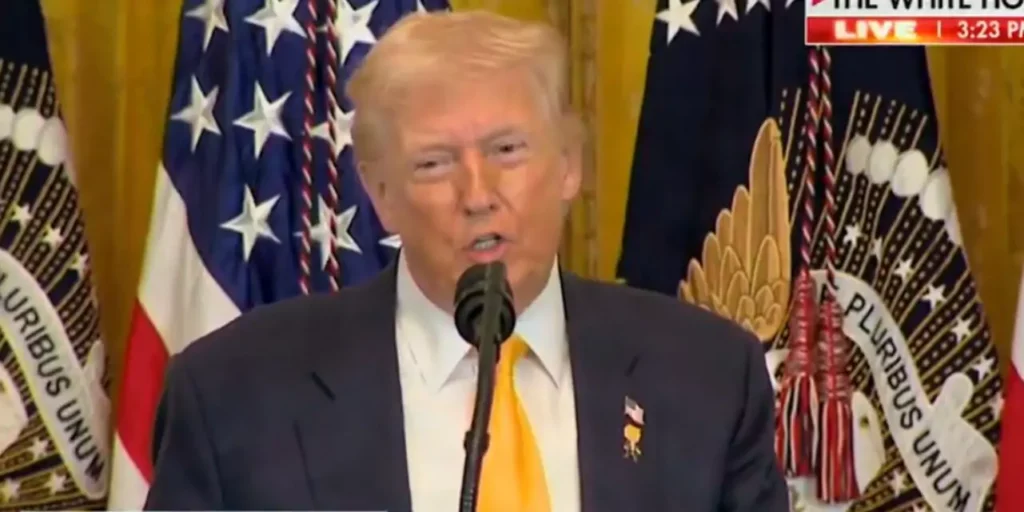
In a movement that shakes international markets this Saturday, February 21, 2026, President Donald Trump announced an immediate increase in global tariffs, going from 10% to 15%. This decision arises as a direct response to the blockade that the Supreme Court imposed a day earlier on its previous commercial strategy.
Although the highest court determined that the president does not have unilateral powers to set global tariffs under the 1977 law, Trump counterattacked using Section 122 of the Trade Act of 1974, which allows him to impose levies of up to 15% for a period of 150 days.
The impact in Mexico and the world
The White House’s tariff policy does not affect everyone equally. The current scheme contemplates specific pressure measurements:
Mexico and Canada: They face a 25% tariff, linked to Washington’s demands on the control of drug trafficking on the border.
Brazil and India: Taxes of up to 50% in retaliation for internal policies and relations with Russia.
End consumer: Analysts at Yale University warn that the effective tariff rate will reach 9.1%, the highest in almost 80 years.
International reaction: Between prudence and rejection
The announcement has generated a wave of global positions this Saturday:
France: President Emmanuel Macron celebrated the existence of counterpowers in the US, although he was cautious and assured that Europe will analyze the consequences to adapt.
Canada: He described the measures as “unjustified,” anticipating a stage of bilateral turbulence.
Asia: Countries like Japan and South Korea maintain their million-dollar investment plans, trusting that their specific agreements from last July (with rates of 15%) remain in force. For their part, Taiwan and Hong Kong foresee a limited impact due to their service-based economic structure.
What will happen to the money already collected?
One of the most critical points after the Supreme Court ruling is the destination of the taxes already collected. While the National Retail Federation celebrates legal “certainty,” figures such as California Governor Gavin Newsom and Senator Elizabeth Warren demand clear mechanisms for the refund of up to $175 billion to affected businesses and consumers.
You may also like
-
Gunman dies after breaking into Mar-a-Lago; Trump was not in the residence
-
Mexico and the US launch massive campaign against screwworm to reopen the border
-
Sheinbaum confirms extraditions for fiscal huachicol and uncovers binational network
-
Former Prince Andrés arrested on his 66th birthday for the Epstein case
-
Peru dismisses its interim president two months before elections and deepens the crisis