
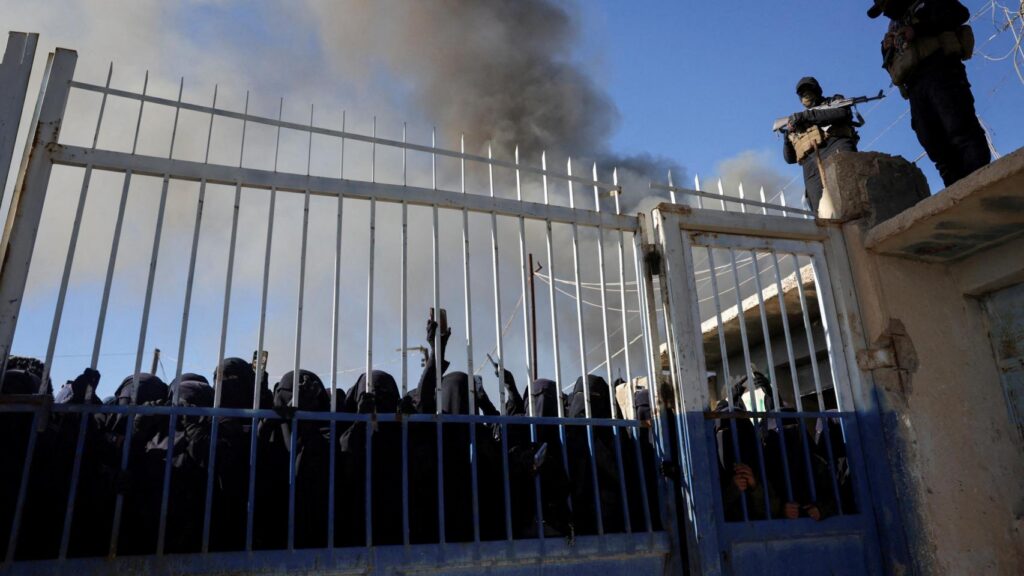
The risk of terrorist attacks has been heightened by the collapse of custody and the disorder prevailing during the transfer to Iraq from northwest Syria of more than 5,700 adult males linked to the Islamic State, held in security centers controlled by Kurdish forces and their partners.
The operation was carried out by the US military command (CENTCOM) between the end of January and mid-February.
The clearest episode of escape with an attributable number occurred in the Shaddadi prison, where, according to American sources, some 200 detainees They escaped during the custody vacuum. “Many” would have been recaptured later, without there being a definitive public balance sheet.
In a statement to the United Nations Security Council, the European Union this month underlined its “deep concern” about the “persistent transnational threat” of islamic terrorism and warned that the situation is “particularly worrying”: the custody and detention of relatives, affiliates and fighters of Daesh, Brussels maintains, requires sustained stabilization and humanitarian efforts to avoid a resurgence.
The risk is “especially disturbing” in the region – Syria and Iraq as operational core and ideological—but in the current jihadist ecosystem, the Central Asian affiliate ISKP or ISIS Khorasan constitutes an “especially acute” threat to Europe due to its capacity to polarize, recruit and radicalize, eroding democratic values and perpetuating fear through attacks.
Among those transferred to Iraq, there is at least one Spanish citizen.
“It is estimated that just over 200 people traveled from Spain to join the Islamic State in Syria and Iraq, including almost 30 women. While some returned before the fall of the so-called caliphate, others died in the conflict zone. Others were captured and held in detention centers and detention camps,” he explains to this newspaper. Devorah Margolinanalista del Washington Institute.
“To date, Spain has repatriated 5 women and 16 minors. In addition, it is estimated that a Spanish man is among the detainees transferred from Syria to Iraq,” adds the specialist.
Regarding the exact fate of that specific Spanish detainee, public information is still fragmentary. Various reports have indicated that some of those transferred have ended up in custody at the Al-Karkh Central Prison in Baghdad, but there is no confirmation.
According to previous journalistic investigations, in 2019 Spaniards were identified in the Kurdish prison system in northeastern Syria. The journalist Natalia Sancha has pointed out that the Spaniard now in Iraqi custody could be one of the two jihadists located then: Omar el Harchi o Zuhair Ahmedalthough the Iraqi authorities have not provided his identification.
In parallel, Spain has carried out repatriations from that ecosystem – the legal and humanitarian labyrinth of camps and detention centers – with little dribs and drabs and under strong operational opacity. The Spanish Ministry of Foreign Affairs has not responded to this newspaper about the number and identification of Spaniards who remain in the region.
In December 2025, it was the United States that reported Spain’s repatriation of a mother and child from northeastern Syria; it would be Ceuta Lubna Miludi and his five-year-old son, relatives of ISIS militants. And in 2023, Madrid repatriated two female jihadists —Yolanda Martínez Cobos y Luna Fernandez— along with thirteen minors.
While the major CENTCOM operation in January and February focused on the movement of adult male detainees to Iraq.
The chaos is not limited to prisons.
UNHCR has confirmed a sharp drop in the population in Al Hol in recent weeks and Damascus’ plan to move the remaining families to a new camp in Akhtarin, Aleppo province.
But the most explosive dimension of the moment has to do with the chaotic emptying of the annex of foreigners.
According to humanitarian organizations, some 6,000 women and children from 42 countries who were held in that annex would have left in a disorganized process without clear traceability, with night departures and uncertain destinations, and with movements to areas around Idlib and Aleppo.
Idlib was for a decade, and continues to be, one of the strongholds of the current president Ahmed al-Sharaaa former jihadist leader who led the Syrian branch of Al Qaeda under the pseudonym Abu Mohamed al Jolani.
After abandoning his radical past and overthrowing the cruel and corrupt regime of Bashar al-Asad In December 2024, the new interim leader officially joined the fight against the Islamic State in November 2025—to which he also temporarily belonged—led by Donald Trumpso he himself is a target.
In Idlib, bordering Turkey, Sharia law and a radical vision of Islam are applied, so it is common for women to wear the niqab. Geography matters: armed networks operated there and part of the displaced population, without documentation or protection, is exposed to trafficking, coercion, recruitment or regrouping.
Europe, in the target
The risk for Europe includes various levels. The escapes of ISIS militants do not imply an imminent attack, but instead favor a mechanism of increased uncertainty.
In terms of security, more potentially radicalized people out of custody equals more burden for intelligence and monitoring, more routes and facilitators, and more opportunities to rebuild networks.
The European Union’s own text insists that ISIS networks are “adaptive and opportunistic”, and that the multilateral architecture of information and cooperation is more important than ever.
At the same time, organizations such as Human Rights Watch warn that transfer to Iraq may involve torture, forced disappearances or unfair trials; and this type of management, in addition to being a problem of rights, can become propaganda and recruitment fuel.
For this reason, Brussels emphasizes a triangle that often fails in practice: secure detention, prosecution and reintegration in accordance with international standards.
For Margolin, the European blind spot is not only moral, but strategic.
Since most European governments have not repatriated their nationals, it is unlikely that everyone will attempt to return to Europe in an open and coordinated manner; and some — especially those who would face criminal charges upon return — may choose not to.
“The chaotic way in which thousands of people from Al Hol were released – including 6,000 foreign women and minors -, without measures such as the provision of adequate documentation or clear repatriation or reintegration plans, leaves the fate of these families unknown,” explains the analyst in dialogue with EL ESPAÑOL.
Many have reportedly moved to the rural areas of Idlib and Aleppo.
“Some foreigners are also trying to return to their countries. For others, who could face criminal charges in their countries of origin, it is unlikely that all of them will try to return,” warns Margolin. “Some of those who remain committed to ISIS may seek to rejoin local jihadist groups, or even move internationally to other hotspots of jihadist activity.”
Washington took charge of the prisoner transfer in a broader political context: the reconfiguration of its presence in Syria and the displacement of its dependence on the Kurdish militias that led the fight against ISIS on the ground.
A decade ago, this radical jihadist group spread terror with numerous attacks in Europe, including the one on Las Ramblas in Barcelona in 2017.
Today, the number verifiable as a completed transfer stands at more than 5,700, although higher figures have circulated in the public debate.
Part of the discussion revolves around how many of those transferred are Syrians and how many are foreigners, as well as the judicial horizon in Iraq.
There is no verified data on the nationalities and percentages of ISIS prisoners, but combining sources from the Washington Institute and the WHO, of the 40,000 militants that the radical jihadist group had, almost 40% were Syrians, 44% Iraqis, and 16% from third countries.
In the most recent collapse in February, the agency Reuters He noted that Al Hol was home to more than 23,000 people including 6,280 foreigners from more than 40 countries. Other unofficial sources indicate that the number of remaining Europeans would exceed 200, but this is not confirmed.
The experts who have analyzed the collapse of Al Hol and the transfer of prisoners agree that what happened portrays, at the same time, the fragility of the new control device and the political bankruptcy of years: no one wanted to resolve “what to do” with these people, and the problem ended up resolving itself and in the worst possible way.
Charles Listerfrom the Middle East Institute, has summed up the moment crudely: “Basically, the Government lost control” of Al Hol after the transfer. “They continued to secure the perimeter, but smuggling increased.”
Desde International Crisis Group, Noah Bonsey has described the background as “a collective failure” of the policies of the governments involved, which left the detainees and their families “caught between security, legal and political pressures” without defining a viable solution.
The final dilemma is political: if Europe does not want to repatriate and does not want to finance extraterritorial confinement indefinitely, the result is an opaque vacuum, that breeding ground in which the Islamic State has always thrived.
You may also like
-
vehicles burned, flights and classes suspended
-
Incredible: Bird droppings fueled the rise of a little-known coastal kingdom, archaeologists reveal.
-
The Armed Forces of Mexico kill ‘el Mencho’, the most wanted drug trafficker and boss of the Jalisco Nueva Generación cartel
-
Brussels asks Donald Trump for complete “clarity” on the tariffs announced after the supreme court’s ruling
-
The US Secret Service kills a man who tried to enter Trump’s residence in Florida