
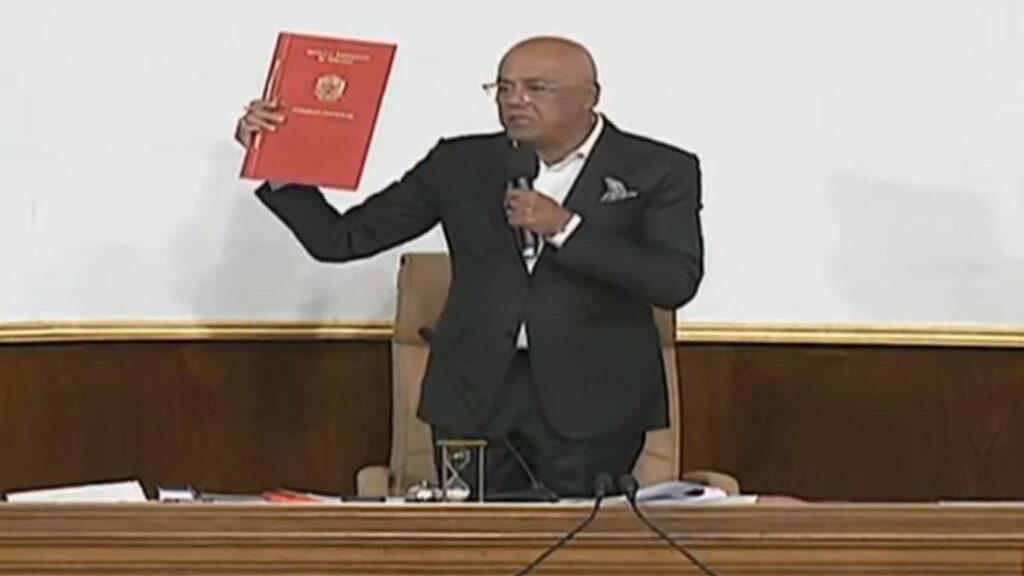
A vaporous 13-point measure promoted by the acting president Delcy Rodriguez which, according to the sweetened version of Chavismo, was born with the vocation of “improving democratic coexistence” at the most delicate moment for the stability of the regime since it came to power 27 years ago.
The new legislation excludes from the application of the amnesty crimes involving serious violations of human rightsagainst humanity, intentional homicide, very serious injuries, drug trafficking, as well as crimes provided for in the law against corruption.

Likewise, it establishes the exclusion of people who are or may be prosecuted or convicted for “promote, instigate, request, invoke, favor, facilitate, finance or participate in armed actions or force against the people, sovereignty and territorial integrity” of Venezuela by “foreign States, corporations or persons.”
In this way, the law leaves political exiles in limbo. A trap directed mainly against leaders such as Maria Corina Machado o Leopoldo Lopezfor whom the government maintains accusations of “promoting, instigating, requesting, invoking, favoring, facilitating, financing or participating in armed or forceful actions.”
The law passed its first reading on February 5. So there was unanimity. In the second reading, however, the deputies of the ruling party got into a dispute with those of the small opposition minority over the content of Article 7 of the lawwhich limits the scope of forgiveness. The processing of the text had been paused for a week.
The deputies approved granting amnesty for acts or “mistakes committed” during different episodes of political crisis that occurred between 2002 and 2025, such as the coup d’état against the late president Hugo Chávez in April 2002, the oil strike at the end of that year and beginning of 2003 and the anti-government protests of 2013, 2017 and 2024.
In addition, a special commission made up of 23 deputies -between opponents and Chavistas- that will develop and implement “mechanisms” to ensure compliance with the law, which has already been sent to the president in charge of Venezuela, Delcy Rodríguez, for signature and subsequent publication in the Official Gazette. Parliamentarians will be able to count on the advice of experts.
In article 7, the subject of differences between parliamentarians and for which the debate was postponed last week, it is established that people must appear in court to request amnesty and allows those who are not in the country to carry out the procedure through a legal representative.
Meanwhile, in the article 11 It is indicated that the competent court will verify the conditions of the amnesty in each case and will decree the nullity of all ongoing processes or the review of final sentences so that they are annulled through a “replacement sentence”, in a period “that will not exceed 15 continuous days.”
The legislation also provides that persons benefited by this law who commit crimes after the entry into force of the amnesty will be prosecuted normally according to the legislation.
This amnesty proposal is part of the “new political moment” announced by Rodríguez, who assumed the Executive after the capture of President Nicolás Maduro during the US military attack on January 3.
The NGO Foro Penal counts 644 political prisoners in the countryafter more than 400 releases in the middle of a process initiated on January 8 by the Government in charge.
You may also like
-
“You can’t have nuclear weapons”
-
Trump’s plan in Gaza includes a military base with capacity for 5,000 troops to control the territory
-
Trump brings “freedom” to Europe with a website for users to bypass controls on social networks
-
The new president of Peru defends that sex at an early age helps women psychologically
-
Monks arrive after 15 weeks of walking: Peace and compassion flood the streets of DC.