
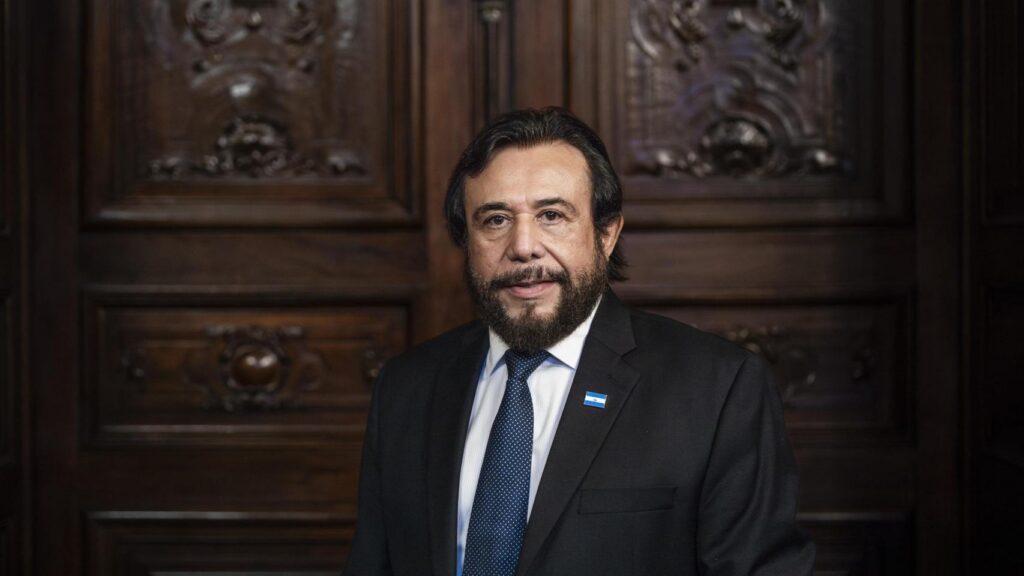
“Another interview?” The half smile barely lasts a second Felix Ulloa (Chinameca, 1951) when he comes across our cameras in one of the noble rooms of Casa de América. Vice President of El Salvador since 2019, when Nayib Bukele swept the presidential elections with historic popular support, Ulloa stopped off this week in Madrid with a clear objective: to combat the story of the bukelephobicas he calls those who maintain that “everything” Bukele does “is wrong.”
But the lawyer does not come alone to fight a semantic battle. He also seeks to build economic bridges with Spain now that his country, he assures, has “won the war against gangs”. He speaks of the “miracle of security,” as he defines the results of the plan designed by Bukele to cleanse the streets of this small Central American country of violence, which until recently topped the world rankings for daily homicides. Today, he boasts, the numbers have plummeted.
This shift — dubbed the ‘Bukele model’ — has turned El Salvador into an object of study and controversy. For some, it is an example of effective heavy-handedness. For others, a warning about the limits of the rule of law. And the cornerstone of this strategy is the state of exceptiona tool that allows constitutional guarantees to be suspended, such as detention without formal accusation, which goes from 72 hours to fifteen days.
Félix Ulloa, Vice President of El Salvador: “There may be innocent people among the 91,000 prisoners”
Decreed in 2022, the measure has been extended month by month until today. Almost 100,000 people have been imprisoned. Some 8,000 have been released after being declared innocent. During this time, organizations such as Human Rights Watch have reported abuses, torture, arbitrary detentions and other violations of human rights in Salvadoran prisons, whose maximum representation is in the famous Terrorism Confinement Center (CECOT), a high-security megaprison.
According to a recent report by the Salvadoran organization Humanitarian Legal Relief470 detainees died during the 45 months of the emergency regime, many of them were admitted healthy and died within a few weeks, which points to possible mistreatment by the penitentiary institution. “People die, they die in prison“They die in hospitals, they die everywhere,” says Ulloa during a previous forum organized by EFE and Casa América.
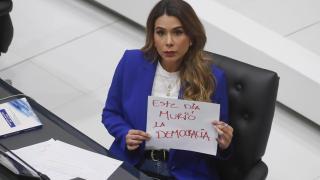
Popular support for Bukele has been key in consolidating this model. After being elected by an overwhelming majority, in 2021 he also obtained an absolute majority in the Legislative Assembly. He took advantage of that control to get rid of critical judges and prosecutors, and reformed the Constitution: first to allow her re-election and then to enable her indefinitely.
For his critics, like the journalist in exile Oscar Martinezauthor of Bukele, the naked King (Anagram Notebooks, 2026)“El Salvador is not a country governed by an administration or by a State, but by a man: Bukele”, whom he considers “a dictator.”
For 20 minutes, EL ESPAÑOL talks with Félix Ulloa about the security strategy of El Salvador, the complaints for violating human rights and the criticism of a president whose popularity and concentration of power have placed the small country of barely six million inhabitants in the global spotlight.
Is El Salvador still a full democracy?
Yes. El Salvador is a model of democracy, although some believe that it is incompatible with strong leadership. Democracy means demos (people) and kratos (power): it is the people who choose their ruler and their representatives through popular consultations, elections. Bukele was elected in 2019 with an absolute majority and re-elected in 2024. As he has continued to deliver results, it is proposed that he could run for a third term. Ultimately, it is the people who delegate their power to both the president and the deputies.
I was wondering because there are numerous reports that speak of a democratic regression, even the end of democracy in El Salvador, precisely because of the constitutional changes that allow indefinite presidential reelection. What do you think about those who consider Bukele a dictator?
First we would have to see what these supposed setbacks are. We received a country governed after the 1992 Peace Accords for 20 years by ARENA and ten by the FMLN, with structural corruption and more than 41,000 murders. Was that democracy? So what is the democratic backsliding? And furthermore, who affirms it and on what basis?
I can quote you one of the reports, the Freedom in the World de 2025 which places El Salvador in 47th place out of 100, speaks of regression due to widespread corruption that undermines democracy and the rule of law.
They are talking about the El Salvador that we received.
Well, it’s 2025. The previous year the country was ranked 53rd.
But it does not say what period it analyzes, because in this Government corruption has been the most fought scourge, because the president offered two things in his campaign: the money is enough when no one steals. There are a number of officials who are in prison, others have already left because they returned the money.
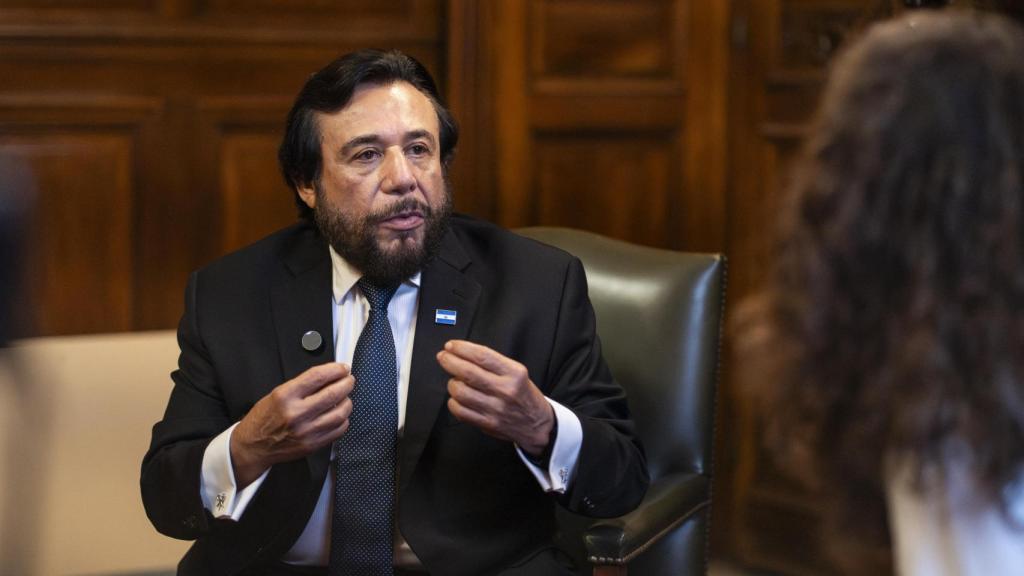
Félix Ulloa at Casa de América during his interview with EL ESPAÑOL.
The Spanish
Is there political persecution in El Salvador?
There is no political persecution; There is persecution for corruption. Even members of the president’s own party have been captured or prosecuted. I don’t know if that report ignores those cases or ignores them.
Is there no risk of concentration of power if a president can perpetuate himself?
No. The president is elected by popular vote; In the last election he obtained 85% in San Salvador and 98% abroad. The Legislature was also elected by a majority: 53 of the 60 deputies are from Nuevas Ideas, freely elected by the people. Nobody is going to pressure them to vote against.
These deputies have approved the dismissal of critical judges and prosecutors, and appointed those most sympathetic.
People who come to block are not elected; Those who will support and share the people’s agenda are chosen. That is the democratic logic we have, of course. The deputies elect the justices of the Supreme Court every three years; Judges serve nine years, with a third renewed every three years. This ensures that the Judiciary reflects the will of the people.
With the Legislative Assembly and the Judiciary under official influence, what counterweight or control exists today over the power of the Executive?
When a people delegates its share of power to a ruler and he governs well, it is ratified; If he governs badly and does not agree, he is removed. Those are the mechanisms of democracy: elections. And when someone says: “but look, Bukele controls the Legislative Assembly or the Judicial Branch,” that is not the case. The people directly elected each deputy, and they did choose them to support the work of the Executive, and that is a sovereign decision of the Salvadoran people.
“The emergency regime has never affected a single public freedom”
Don’t you think that even in a liberal democracy institutional limits are needed, even if they sometimes contravene the will of the people?
So, if it goes against the people, it is no longer democracy, but a dictatorship. In post-war liberal democracies there was talk of systems with supposed institutional controls, but in reality it was the de facto powers that were in charge. In a true democracy, controls are established by the people. The problem arises when the elites speak on behalf of the people or when there are leaders who claim to represent them: in that case, it is no longer democracy.
There is no one then who can say “no” to President Bukele.
Why would you want one body to limit or block the actions of another, in this case the Legislature or the Executive, to demonstrate that there is democracy? If both are in the same vision and project, that is democratic coherence.
His government claims to have achieved the “security miracle,” winning the war against gangs and reducing the homicide rate to historically low levels. What then justifies maintaining the state of exception, which restricts certain rights and freedoms of citizens, four years later?
The emergency regime, since it was decreed on March 27, 2022, has never affected a single public freedom, not a single one. It only suspends constitutional guarantees for private individuals, not for the Salvadoran people. That is, normal people who do not belong to criminal structures do not suffer these types of extraordinary measures. Furthermore, when the people were asked in a survey a week ago if they wanted the emergency regime to continue, 97% said yes. If the majority wants it, why are they going to remove it?
If there is no longer violence and, as it says, the Salvadoran people are not affected, what function does it have?
For the collective imagination, the regime of exception is the protection of the welfare state in which it is found. Since the state of emergency was declared and they began to capture all the gang members, put them in jail and restore peace, happiness, and security to the communities, people feel free, so they believe that because of the State they want it to continue.
¿Cuándo planean restablecer plenamente las garantías constitucionales?
Cuando el pueblo diga que ya no lo quiere, si la excepción quita las garantías suspendidas es para beneficio del pueblo y si el pueblo lo percibe así la va a querer porque se siente seguro.
¿Podría decirme exactamente cuántos detenidos hay en las cárceles salvadoreñas?
Más de 91.000.
¿Y cuántos de ellos ya han sido juzgados?
Miles, porque son juicios colectivos y otros están esperando los procesos. Esos que no han llegado a juicio, sí pasaron la etapa de instrucción. Para estar detenida, una persona necesita que el juez haya decretado la detención provisional. Tras la captura, la policía entrega al Ministerio Público, que tiene 15 días para recabar pruebas y decidir si las remite al juez. Si no hay elementos suficientes, la persona queda libre; si los hay, el juez revisa el caso con defensores, y si la evidencia es sólida, pasa a juicio. El Estado ha nombrado más de 300 abogados de oficio para quienes no pueden pagar.
Desde el domingo, la comida es racionada y los 16,000 pandilleros encarcelados no han salido de sus celdas, ni han visto el sol.
En estos días hemos arrestado 3,000 más (y seguimos).
Así que cada vez habrá menos espacio y tendremos que racionar aún más.#GuerraContraPandillas pic.twitter.com/03MbAEzMPY
— Nayib Bukele (@nayibbukele) March 31, 2022
¿Cuánto tiempo puede pasar desde la detención hasta que se inicie un juicio?
Eso lo determinan los 11 jueces que solo juzgan a las pandillas.
En el último año se han liberado a 8.000 inocentes detenidos…
Bueno, se les ha declarado inocentes, yo no sé si eran inocentes. O sea, presentaron pruebas de arraigo, de trabajo, de estudio, y los habían agarrado por una mala información o por un error, fueron liberados.
¿Podrían liberarse más personas inocentes?
Eso lo deciden los jueces. Yo soy del Ejecutivo, pero podrían haber inocentes entre esos presos, como en cualquier parte del mundo, donde hubo personas que fueron condenadas a muerte y fusiladas y eran inocentes.
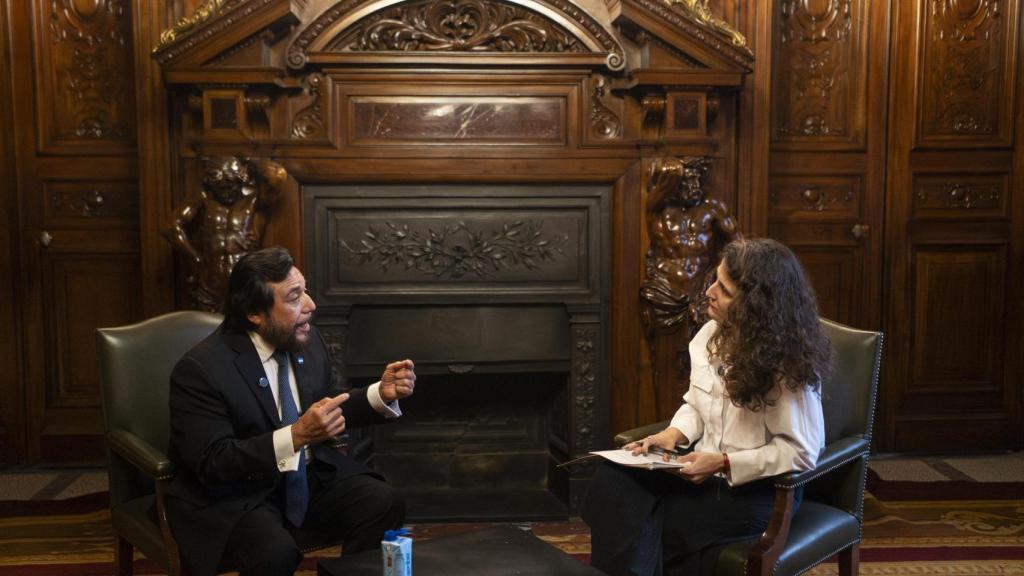
Félix Ulloa durante su entrevista con EL ESPAÑOL.
Human Rights Watch y otras organizaciones han documentado detenciones arbitrarias, tortura, malos tratos incluso contra menores. ¿Se vulnera los derechos humanos de los presos?
No, no. Yo no sé cuál es la fuente de esos informes porque ellos nunca han ido a una cárcel. Cuando lograron presentar los casos que los documentaron, lo llevamos a la Comisión de Derechos Humanos, Ginebra y fue el Gobierno y fue demostrando caso por caso que no eran ciertos.
Los informes cuentan con entrevistas, fotografías…
Insisto, la única institución que va a las cárceles, que tiene mandato para ir a la cárcel por un voto con el Gobierno, se llama Comité Internacional de la Cruz Roja y ellos sí hacen informes de lo que observan de lo que ven y nos han hecho críticas y hemos tomado sus críticas, porque son instituciones serias. No son las organizaciones estas, que toman lo que un señor me dijo o la prensa o el medio tal o una ONG de oposición.
Dice que no han ido a las cárceles, ¿se lo han solicitado?
¿Estos niños? no sé, no sé.
En los últimos años su Gobierno ha organizado visitas de influencers al CECOT, la cárcel de máxima seguridad. Hay muchos medios que lo han criticado como una estrategia de imagen, como una propaganda. ¿Cuál es el objetivo real de estas visitas y qué busca transmitir el Gobierno con ellas?
La verdad es que no lo sé porque eso pertenece al sistema carcelario. No sé quién ha ido. Cuando me llegan solicitudes yo se las paso al Ministerio de Justicia o a quien esté a cargo de las cárceles. Lo que sí me dijeron era que no pasara caso por caso, que reuniera un grupo, porque si no todos los días tendríamos ahí a alguien, y ni que eso fuera un zoológico .
“Los padres son los últimos en enterarse de que sus hijos son miembros de una mara”
En el último año Estados Unidos ha deportado a El Salvador a centenares de migrantes. A cambio, según varios informes, de millones de dólares. ¿No teme que estos acuerdos transformen al país en un destino permanente para presos extranjeros?
No, no, no, porque era solo un caso. Estados Unidos capturó a un grupo de miembros del Tren de Aragua y tenía planeado deportarlos a Venezuela, pero ese país no los quiso recibir. Entonces solicitaron alojamiento carcelario en El Salvador y se les dijo que sí, con gusto, aunque nosotros no podíamos mantenerlos indefinidamente, así que se fijó un precio por tenerlos aquí. Cuando Estados Unidos se puso de acuerdo con Venezuela y este país liberó a presos políticos que tenían bajo bandera estadounidense, Estados Unidos dijo: “Bueno, dádmelos a mí, que los voy a mandar allá”.
¿O sea que fue algo excepcional?
Sí, no hay un flujo de presos que está llegando, ni deportados, ni nada.
En los últimos días han surgido testimonios de familiares de presos que denuncian que los juicios masivos de centenares de personas podrían vulnerar los derechos de los reclusos. ¿Qué le diría, por ejemplo, a una madre que está solicitando un juicio justo para su hijo?
Primero, le diría que mire si su hijo cometió o no cometió delito, si era miembro de una mara o no. Porque los últimos que se dan cuenta de que sus hijos eran de una mara son las madres o los padres, la casa. Entonces le diría que vaya y averigüe. Los juicios son públicos, hay defensores; que busque uno, que lleve el expediente y que le expliquen: “Mire, su hijo pertenece a esta mara”. Quizá no era quien disparaba o quien mataba, ni uno de los jefes, pero podía ser quien cobraba la extorsión. Y eso también implica responsabilidad. Aquí no se juzga caso por caso de manera aislada, porque no puede haber 90.000 procesos individuales: eso tomaría cien años y requeriría millones de jueces. Se juzga a la estructura y se sanciona según el grado de responsabilidad que cada individuo haya tenido dentro de esa estructura.
¿Juzgarlos de manera masiva no vulnera algunas de sus garantías fundamentales como individuos?
Eso es lo que decía, porque por eso preguntaba si alguno de ustedes [en la conferencia previa] He had training as a lawyer, because if you don’t have one you won’t understand it.
You may also like
-
Three dead in a new US attack against an alleged drug boat in the Pacific
-
Kim Jong-un boasts of North Korea’s military power, shows off his new nuclear rocket and celebrates economic improvement
-
The blind spots of the amnesty law in Venezuela: it does not reverse the expropriations or the disqualification of opponents
-
Two 16-year-olds arrested for preparing an imminent jihadist attack
-
Alessio Lisci, the Italian who opted for Spain to become a coach