The United States is looking for a way to avoid the filters that authorities in other countries intend to apply to limit access to social networks. A website will allow you to enjoy the ‘freedom’ that Trump wants to impose in Europe.
Three words in English are written with blue letters on a black background. The first one is pixelated. Only when you slide the cursor over it can it read ‘Freedom’ and the full phrase is revealed: “Freedom is coming.”
The silhouette of a rider riding a steed gallops above the slogan. It is the image of the legendary Paul Reverethe man who announced to his countrymen the arrival of the British troops; a symbolic episode of the independence of the United States of America.
Trump rides like a new Paul Revere to announce to the world that freedom will soon arrive: “Information is power. Claim your human right to freedom of expression. Get ready,” reads the slogan on the screen. It is the front page of a website promoted by the United States Administration to respond to the limitations on access to digital platforms announced by different countries.
The Australian Government was the pioneer of limitations: in November it introduced an amendment to its Online Safety Act of 2021 forcing X, Facebook, Instagram, Tik Tok, and other popular platforms to take “reasonable measures” to block access to minors under 16 years of age.

Verification systems may include facial recognition and the use of artificial intelligence. The law will not sanction users, but may impose fines of up to 30 million euros on platforms that fail to comply.
The French National Assembly At the end of January, it approved a law that prohibits access to social networks for minors under 15 years of age. It also prevents the use of mobile phones in schools.
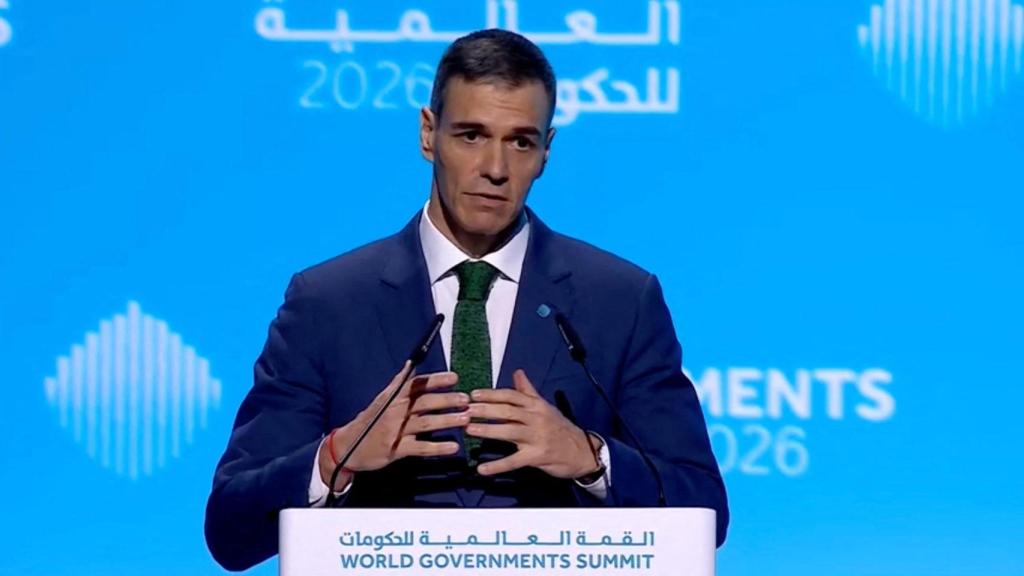
Pedro Sánchez at the World Government Summit. Dubai, February 2026.
Reuters.
Along the same lines, on February 3, Pedro Sánchez announced in the World Government Summit that “Spain will prohibit access to digital platforms for minors under 16 years of age.” Sánchez raised the need to “recover control of digital governance” so that networks are a “healthy and democratic space.”
Sánchez’s statements were echoed on the other side of the Atlantic: Elon Musk reacted quickly on his X network (Twitter) harshly criticizing the measures against digital platforms. He called Sánchez a “tyrant” and a “traitor,” in a tense exchange that escalated with mutual accusations.
More than 15 states have announced similar initiatives. There is growing concern to protect the mental health of minors and restrict indiscriminate access to inappropriate content. He European Parliament Last November, it approved a non-binding resolution recommending that member states implement restrictions on minors under 16 years of age.
Worrying data
The Commission relied on reports showing that a 97% of young people connect to social networks daily and 78% of young people between 13 and 17 years old check their mobile phone at least once every hour.
The report specifies that 90% of Europeans consider it urgent to protect children online. 93% consider that networks are harmful to children’s mental health and 92% that they encourage cyberbullying.
Sarah Rogersundersecretary for the State Department Public Diplomacy of the Washington government, leads the project of a portal that will allow users to bypass access restrictions anywhere in the world.
According to Reuters, the Trump Administration planned to announce its launch during the last Munich Security Conferencebut the launch has been postponed. The causes have not been confirmed, although legal sources from the State Department speak of unspecified concerns about the legality of the project.
Official sources in Washington denounce that some directives, such as the European Union Digital Services Law o to Online Security Law British, limit the dissemination of content related to far-right policies. This attacks the supposed freedom of expression promoted by the Trump Administration.
The State Department’s initiative comes at a time of rising tension in relations between both sides of the Atlantic. The main disputes revolve around security, immigration, trade and sovereignty. The gap widens and reveals a climate of mutual distrust.
Trump has declared admirers in Europe. Some already installed in power, like Orbán, Fico or Nawrocki. Others are waiting for their opportunity and social networks are an indispensable instrument to move their youngest followers.
In such a context, the launch of a digital tool that overcomes barriers to access to networks and content would clash head-on with the European regulator: the Brussels authorities already frequently require platforms based in the United States to remove content and can impose access restrictions.
There are recent precedents: the Commission sanctioned X (formerly Twitter) with a fine of 130 million euros for failing to comply with the Digital Services Law. “It’s very unpleasant,” Trump said when asked by reporters. “Europe is on the wrong path, very bad for people,” he added.
You may also like
-
The new president of Peru defends that sex at an early age helps women psychologically
-
Monks arrive after 15 weeks of walking: Peace and compassion flood the streets of DC.
-
many were deceived with false promises
-
“It is no longer a focus of terrorism”
-
This is how Greece will punish NGOs that facilitate the entry of immigrants